



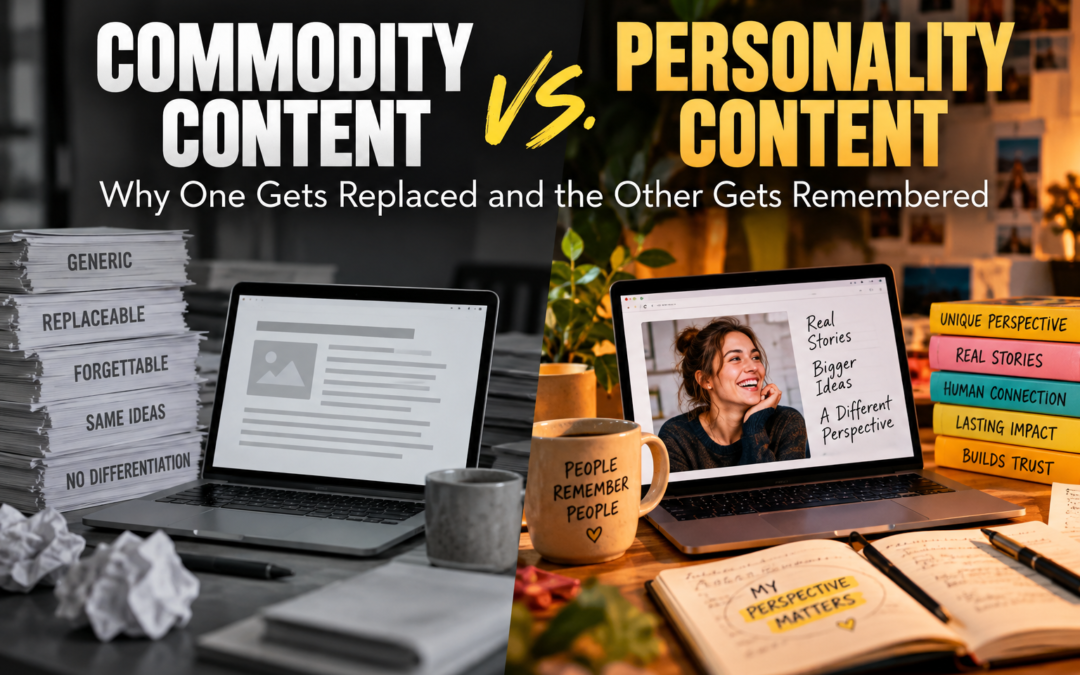
Commodity Content vs. Personality Content: Why One Gets Replaced and the Other Gets Remembered
In a world overflowing with information, your greatest marketing advantage might be something you’ve had all along: YOU.
Have you ever read a blog post, scrolled through a social media feed, or opened a marketing email and thought, Haven’t I seen this somewhere before?
Same advice. Same familiar phrases. Same five tips presented in a slightly different order.
There’s nothing necessarily wrong with the information. It might even be helpful. But five minutes later, you’ve forgotten who shared it.
Now think about the last time you read something that made you smile, nod your head in agreement, or say, “Oh my goodness, that happened to me, too!”
Chances are, you remember more than the message. You remember something about the person behind it.
And that, my friends, is where the magic happens.
When Everything Starts Sounding the Same
There’s a term floating around marketing circles these days called commodity content.
It sounds a little technical, but the idea is simple.
Commodity content is information that could come from practically anyone. It’s the familiar advice we’ve heard dozens of times, the predictable articles, and the social media posts that sound as though everyone is reading from the same script.
You know the ones.
“Five Ways to Grow Your Business.”
“Ten Tips for Better Customer Service.”
“How to Be More Productive.”
There’s certainly a place for these articles. People need practical information, and sometimes a straightforward answer is exactly what they’re looking for.
But here’s the question I want you to consider:
If someone removed your name from your content, would readers know it came from you?
Would they recognize your voice, your perspective, or your way of looking at the world?
Or could your words belong to just about anyone?
That’s the difference between simply sharing information and creating something people remember.
Your Personality Is Part of Your Brand
When I think about the businesses and businesswomen I’ve admired over the years, I rarely remember them because they had the fanciest website or the most perfectly polished marketing materials.
I remember their stories.
I remember the woman who started her business at her kitchen table while raising three children.
I remember the entrepreneur who turned a frustrating experience into an entirely new business idea.
I remember the business owner who made me laugh when she described a spectacular marketing mistake—and what she learned from it.
Those stories stay with us because they’re human.
They’re not manufactured. They’re not interchangeable. And they’re certainly not boring.
That’s what I call personality content.
It’s content that allows your readers to get to know the person behind the business.
And here’s something I wish more women entrepreneurs understood:
You don’t have to be outrageous, outspoken, or larger than life to have a memorable personality.
You can be quiet and thoughtful. Warm and encouraging. Funny and a little quirky. Practical and straightforward.
You can even be an introvert who would rather write a thoughtful article than stand in front of a room full of strangers.
The point isn’t to become someone else.
It’s to allow more of who you already are to come through in what you share.
A Little Story Can Make a Big Difference
Let me give you an example from my own experience.
I’ve been in the floral business for more than four decades, and I could write countless articles about choosing flowers, caring for arrangements, or selecting the perfect gift.
Those articles would certainly be useful.
But what if, instead, I told you about a customer who came into my flower shop looking for a bouquet and left having shared a story about someone she loved?
Or a time when a seemingly ordinary flower delivery became part of an extraordinary moment in someone’s life?
Those are the stories that remind us why we do what we do.
And they tell readers something about my business that a list of flower-care tips never could.
They show the heart behind the flowers.
The same principle applies whether you sell handmade jewelry, offer consulting services, run an online boutique, publish books, or manage a multimillion-dollar company.
Your experiences give your business a personality that no competitor can duplicate.
And Then There’s AI…
We can’t have this conversation without mentioning artificial intelligence.
AI has made creating content easier than ever. You can generate article ideas, draft emails, outline blog posts, and brainstorm marketing campaigns in a fraction of the time those tasks once required.
And I think that’s wonderful.
But there’s something worth remembering.
AI can help you write about entrepreneurship. It hasn’t lived your entrepreneurial journey.
It doesn’t know what it felt like when you made your first sale.
It wasn’t there when you wondered whether you could make payroll, when a customer surprised you with an unexpected kindness, or when you celebrated a milestone that once seemed impossible.
It can help you find the words to describe those moments.
But the experiences themselves belong to you.
That’s why I believe the most interesting opportunity isn’t choosing between AI and authentic content.
It’s learning how to use technology to make your work easier without allowing it to erase the very personality that makes your business different.
Let AI help with the heavy lifting.
But don’t hand over your voice.
Five Ways to Put More YOU Into Your Content
If you’re wondering how to make your marketing a little more personal, you don’t have to overhaul everything you’re doing.
Sometimes the smallest changes make the biggest difference.
1. Tell the story behind the advice
Instead of simply sharing five lessons you’ve learned about running a business, tell readers how you learned one of them.
Was it a mistake? A surprising success? Something a customer said?
A lesson wrapped in a real experience is often far more memorable than advice standing alone.
2. Share what you really think
You don’t have to agree with every popular business trend.
In fact, some of the most interesting conversations begin when someone says, “I know everyone recommends this, but here’s why I do things differently.”
Your perspective matters.
And you might be surprised how many people have been waiting for someone to say exactly what you’ve been thinking.
3. Let readers peek behind the curtain
People enjoy seeing what happens behind the scenes.
Share the inspiration behind a new product, the unexpected challenge of launching a service, or even the little rituals that help you get through a busy day.
Not every story has to be dramatic.
Sometimes a cup of coffee, a cluttered desk, and an honest observation about the day ahead are enough to create a connection.
4. Don’t polish away every bit of personality
I love a well-written article. But I also love writing that sounds like a real person.
If you naturally use humor, let it show.
If you have a favorite expression, use it.
If you tend to ask questions or tell stories before getting to the point, that may be part of what makes your writing yours.
Professional doesn’t have to mean impersonal.
5. Invite people into the conversation
Instead of ending every article with a predictable call to action, ask something that encourages readers to share their own experiences.
What’s the most unexpected lesson you’ve learned in business?
What customer interaction will you never forget?
What’s something you do differently from everyone else in your industry?
Good content doesn’t always have to deliver the final word.
Sometimes its greatest value is starting a conversation.
You Don’t Have to Share Everything to Be Authentic
Before we go any further, I want to make one important distinction.
Being personal doesn’t mean making every part of your life public.
You get to decide what you share.
You can tell meaningful stories without revealing private details. You can express opinions without becoming controversial. You can show your personality without turning your business into a reality show.
Authenticity isn’t about how much you reveal.
It’s about whether what you choose to share genuinely reflects who you are.
And for women entrepreneurs who have spent years trying to look, sound, and behave a certain way to be taken seriously, that can be a wonderfully liberating realization.
The Woman Behind the Business Is Worth Remembering
When I started my first business, long before websites, social media, and AI became part of our everyday vocabulary, one thing mattered enormously: relationships.
People did business with people they knew, liked, and trusted.
They remembered how you treated them.
They told their friends about you.
They came back because they felt a connection that went beyond the product or service you sold.
Technology has changed almost everything about how we market our businesses.
But I don’t believe it has changed that fundamental human desire to connect.
We still want to know who’s behind the company.
We still appreciate a good story.
We still remember the people who make us feel something.
And perhaps that’s the greatest opportunity for women in ecommerce today.
We don’t have to compete by producing more content than everyone else.
We can compete by creating content that means more.
Content with warmth. With wisdom. With humor. With experience. With heart.
Because information may bring someone to your website, but personality gives them a reason to remember you—and perhaps come back.
So the next time you sit down to write a blog post, prepare a newsletter, or create something for social media, ask yourself one simple question:
Where am I in this message?
If your answer is “nowhere,” maybe it’s time to put a little more YOU into what you share.
After all, there are millions of businesses competing for attention online.
But there’s only one you.
And that’s a competitive advantage worth celebrating.
Let’s Talk!
Have you ever followed a business, subscribed to a newsletter, or purchased something simply because you connected with the person behind it?
I’d love to hear your story. And if you’re a business owner, tell us: What’s one thing about your personality that makes your business uniquely yours?
— Heidi Richards Mooney

