




For years, businesses focused on Google rankings, social media engagement, and online reviews to manage their digital reputation.
Today, there is a new gatekeeper to visibility: Artificial Intelligence.
Millions of consumers are now asking questions directly to AI platforms instead of traditional search engines:
- “What is the best CRM for small businesses?”
- “Who are the top women entrepreneurs to follow?”
- “What is the best hormone clinic in Florida?”
- “Which leadership books should I read?”
- “Who are the experts in ecommerce?”
The answers they receive are often generated by AI systems that pull information from multiple sources across the web, analyze sentiment, evaluate authority, and summarize what they believe to be the most relevant information.
The challenge?
Many business owners have no idea what AI is saying about them.
That’s where an AI Search Scan comes in.
What Is an AI Search Scan?
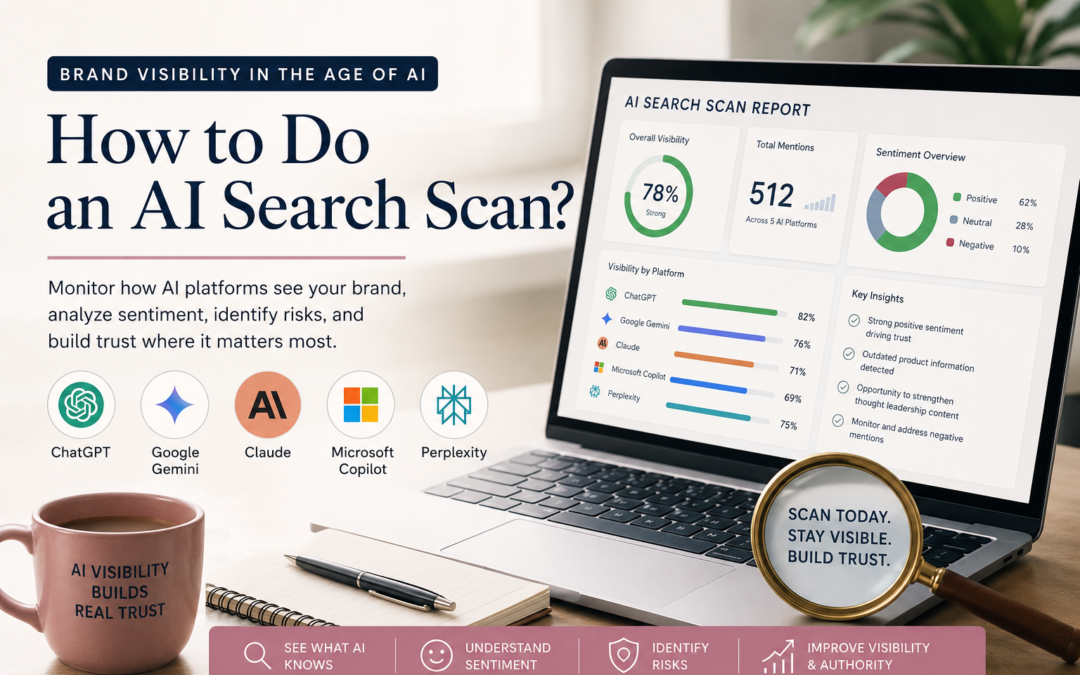
An AI Search Scan is a comprehensive review of how your brand, company, products, services, executives, and content appear across major AI platforms.
Think of it as a reputation audit for the AI era.
Rather than focusing solely on where your website ranks in Google, an AI Search Scan examines:
- Whether AI systems recognize your brand
- What information they provide
- Which sources they trust
- Whether facts are accurate
- How often your business is mentioned
- The emotional tone associated with those mentions
- Potential misinformation risks
- Opportunities to improve future visibility
The goal is simple:
Understand what AI knows about you before your customers do.
Why AI Visibility Matters
Consumers increasingly trust AI-generated answers because they appear objective and comprehensive.
If an AI assistant recommends your competitor instead of you, that influences buying decisions.
If it repeats outdated information, that can damage credibility.
If it cannot find enough information about your company, you may become effectively invisible in AI-assisted searches.
The brands that proactively manage their AI presence today will likely have a significant advantage tomorrow.
The Five Major AI Platforms to Monitor
Not all AI systems learn the same way.
Each model relies on different data sources, ranking signals, partnerships, and retrieval methods.
Understanding those differences is essential when conducting an AI Search Scan.
1. ChatGPT
ChatGPT is one of the most widely used AI assistants in the world.
Its responses are influenced by:
- Public websites
- News articles
- Educational resources
- Structured online data
- Business websites
- Reviews and third-party content
- Real-time web retrieval (when enabled)
ChatGPT tends to prioritize:
- Authoritative sources
- Well-structured content
- Consistent brand information
- Credible publications
Businesses that appear frequently in respected publications often gain greater visibility within ChatGPT-generated responses.
2. Google Gemini
Gemini benefits from Google’s vast search ecosystem.
It heavily incorporates:
- Google Search signals
- Google Business Profiles
- Knowledge Graph data
- Reviews
- News content
- Website authority metrics
Gemini often excels at identifying local businesses and established organizations with strong search visibility.
If your SEO foundation is weak, Gemini visibility may suffer as well.
3. Claude
Developed by Anthropic , Claude places strong emphasis on safety, reliability, and contextual understanding.
Claude often favors:
- High-quality educational content
- Research-driven sources
- Expert thought leadership
- Long-form authoritative articles
Brands that publish useful educational content often perform particularly well in Claude-generated responses.
4. Microsoft Copilot
Copilot draws heavily from:
- Microsoft Bing
- News sources
- Web content
- Business profiles
- Public authority signals
Businesses with strong Bing visibility frequently see better representation in Copilot.
Since Bing powers numerous AI experiences across Microsoft’s ecosystem, visibility here can influence a wide range of AI-assisted searches.
5. Perplexity
Perplexity has become popular because it provides source citations for its answers.
It frequently relies on:
- News websites
- Industry publications
- Academic content
- Current web information
- Trusted reference sources
Because Perplexity openly cites its sources, it is often easier to identify exactly where information is coming from and what influences brand visibility.
Sentiment Analysis: What AI Thinks About You
One of the most valuable aspects of an AI Search Scan is sentiment analysis.
Modern AI systems don’t simply count mentions.
They evaluate context.
Every mention can typically be categorized as:
Positive
Examples include:
- Expert recognition
- Positive customer reviews
- Awards and achievements
- Media features
- Successful case studies
Neutral
Examples include:
- Directory listings
- Business descriptions
- Factual references
- Company profiles
Negative
Examples include:
- Complaints
- Negative reviews
- Public controversies
- Critical articles
- Customer disputes
When AI systems repeatedly encounter positive references, they often associate greater trust and authority with a brand.
Conversely, recurring negative references can influence recommendations and summaries.
An AI Search Scan helps determine whether your digital footprint is strengthening trust or weakening it.
Identifying AI Reputation Risks
One of the biggest benefits of an AI Search Scan is uncovering hidden vulnerabilities before they become widespread.
Common issues include:
Outdated Product Information
AI may continue repeating:
- Old pricing
- Retired services
- Discontinued products
- Former leadership information
Inconsistent Brand Messaging
Different websites may describe your business differently.
AI systems may struggle to determine which version is accurate.
Negative Legacy Content
Older articles, reviews, or complaints can continue influencing AI-generated responses long after the issue has been resolved.
Missing Authority Signals
Many businesses simply don’t have enough trusted content available online for AI systems to confidently reference them.
How to Conduct Your Own AI Search Scan
Start by asking each AI platform the same questions:
- Who is [Your Name]?
- What is [Your Company] known for?
- What products or services does [Your Company] offer?
- Who are the leaders in [your industry]?
- What are the best solutions for [problem you solve]?
Document the responses.
Look for:
- Accuracy
- Completeness
- Source quality
- Sentiment
- Consistency
Notice which competitors appear more frequently than you do.
Those visibility gaps often reveal opportunities.
How to Improve Future AI Visibility
The good news is that AI visibility can be improved.
Focus on building what AI systems consistently reward:
Publish Expert Content
Create:
- Articles
- Guides
- White papers
- Case studies
- Interviews
Expert content gives AI systems credible information to reference.
Strengthen Your Digital Footprint
Ensure consistency across:
- Your website
- Social profiles
- Business directories
- Author bios
- Media mentions
Earn Third-Party Validation
AI systems often trust independent sources more than self-published claims.
Seek:
- Media coverage
- Podcast interviews
- Industry awards
- Guest articles
- Expert roundups
Update Old Information
Regularly review:
- Company descriptions
- Product pages
- Executive bios
- Press materials
Accurate information helps reduce misinformation risks.
Build Topical Authority
Rather than trying to be known for everything, become highly visible around a few core topics.
AI systems are increasingly identifying experts based on topic concentration and consistency.
The Future of Reputation Management
AI Search Scans are rapidly becoming as important as website analytics, SEO reports, and social media monitoring.
The businesses that thrive in the coming years won’t simply optimize for search engines.
They’ll optimize for AI understanding.
Because in an AI-driven world, visibility isn’t just about being found.
It’s about being understood, trusted, recommended, and remembered.
The question is no longer whether people are searching for you online.
The question is whether AI knows enough about you to recommend you when they do.

