



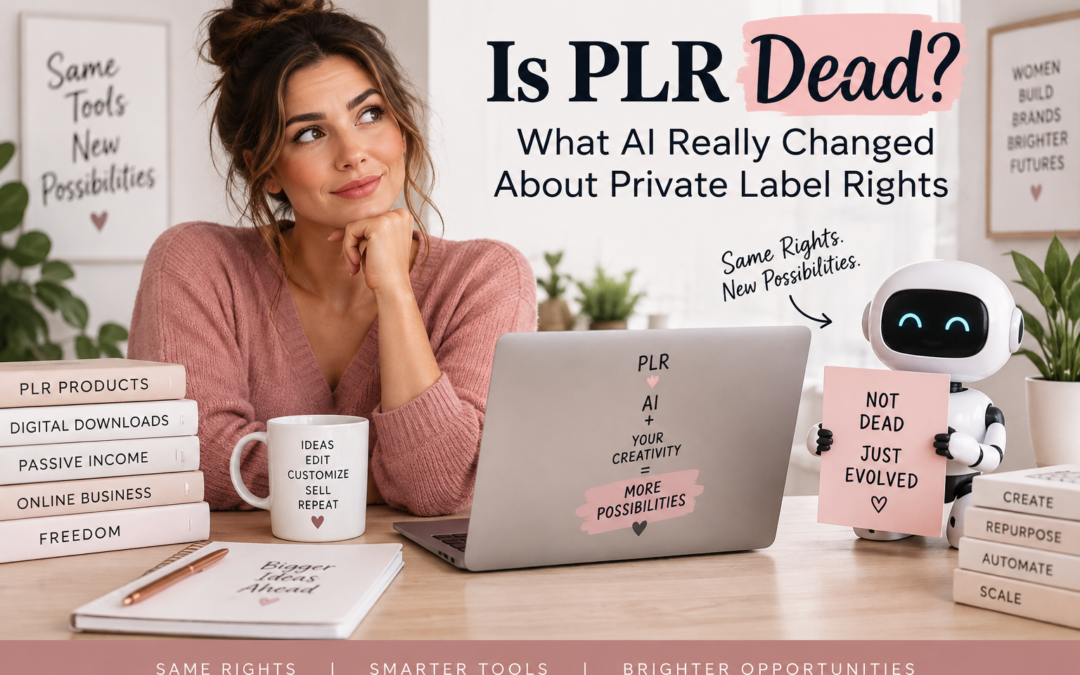
With AI making it easier than ever to generate your own content in seconds, it’s a fair question: is PLR (Private Label Rights) dead?
The honest answer is more interesting than a simple yes or no. AI didn’t kill PLR — but it did completely change what PLR is good for, who uses it, and how.
A Quick Refresher: What Is PLR, Anyway?
Private Label Rights content is pre-made material — articles, ebooks, courses, templates, graphics, even video — that you can legally purchase, rebrand, edit, and resell (or reuse) as your own. Unlike simple resale rights, PLR typically lets you claim a level of ownership over the content itself: change the author name, adjust the branding, edit the material, and put it out under your own name or business.
It’s not a new or shady concept, either. The same logic runs quietly through the physical retail world — private label products like Walmart’s Great Value or Costco’s Kirkland brand are essentially PLR: manufactured by someone else, then relabeled and sold as the retailer’s own.
The Case That AI Killed PLR
Before AI tools became mainstream, PLR thrived because it solved a real problem: content took time to create, and PLR was cheap, fast, and already written. But it had a well-known flaw from the start — it was often generic, broad, and repetitive by design, since it was built to appeal to as many buyers as possible. Buyers frequently had to rewrite large chunks of it anyway just to make it feel original or valuable.
Once AI tools capable of generating custom content on demand became widely available, that trade-off collapsed. Why buy a generic, one-size-fits-all article you still need to heavily edit, when you can prompt an AI tool to write something tailored to your specific voice and audience from scratch, in seconds? For a lot of the low-effort, mass-market PLR product — the kind designed to be resold with minimal editing — that argument is hard to beat, and that segment of the PLR market genuinely has shrunk.
The Case That AI Actually Saved PLR
Here’s the twist: rather than replacing PLR, AI has become the tool that makes PLR better. The most current thinking in the space flips the original narrative entirely — AI doesn’t compete with PLR, it enhances it. PLR provides a verified structure and foundation; AI provides the fast, unique rewrite on top of it.
That distinction matters more than it might seem. A blank page and an AI prompt can produce content quickly, but it still requires you to know what to ask for, structure it well, and often fact-check or refine it substantially. A quality PLR product — a well-researched course outline, a proven ebook structure, a tested email sequence — gives you a vetted foundation. Feed that into an AI tool for rewriting, personalizing, and rebranding, and you get speed and quality, instead of having to choose between them.
This is also showing up in how PLR products themselves are evolving. AI-powered video creation paired with PLR scripts and content is being used to produce polished video content at a speed and scale that wasn’t possible even a couple of years ago — turning PLR from a static, one-and-done asset into raw material for an entirely new format.
Where PLR Still Makes Sense in an AI World
Curated, done-for-you libraries. As content creation gets easier, a new bottleneck has emerged: content curation. Professionals are busier than ever and don’t have time to sort through everything AI can generate — so businesses built around selecting, refining, and packaging the best PLR content for a specific niche audience (say, real estate agents or fitness coaches) are proving to be a viable, sustainable model, often even structured as recurring subscriptions.
Structured, higher-stakes content. Courses, coaching programs, and training materials benefit enormously from a proven instructional structure — something PLR providers who specialize in course design already have refined. AI can then personalize the delivery, but the underlying framework doesn’t need to be reinvented from zero every time.
Speed for non-writers. Not everyone wants to become a prompt engineer or content strategist. For many small business owners, a well-built PLR product still offers a faster, simpler starting point than learning to wrangle AI tools effectively from scratch.
What to Watch Out For
If you’re considering using PLR content today, a few things matter more than ever:
- Customize, don’t just relabel. Both platforms and audiences are increasingly sensitive to generic, obviously unedited content. If you use PLR, treat it as a starting draft, not a finished product — this is also often a licensing requirement, not just a best practice.
- Know your license terms. Most PLR licenses allow you to edit and resell the content as your own, but typically prohibit passing along those same private label rights to your own customers. Read the license carefully before you build a business around it.
- Quality still varies wildly. The barrier to creating and selling PLR is also low, which means the market is flooded with both excellent and mediocre products. Vet your source the same way you’d vet any other supplier.
- Disclosure isn’t usually required — but honesty still matters. Most PLR licenses don’t require you to tell customers the content originated as PLR, and you’re generally allowed to market it as your own. That said, if someone asks directly, be honest. Focus your marketing on the value the product provides rather than a fabricated creation story.
So, Is PLR Dead?
No — but the version of PLR that thrived purely on being “cheap and fast” is fading, because AI can now be cheap and fast too, without the compromises. What’s replacing it is a more refined model: PLR as a foundation, not a finished product — combined with AI to make that foundation faster to customize, easier to personalize, and genuinely unique by the time it reaches your audience.
The real question isn’t whether PLR is dead. It’s whether you’re still using it the old way — or using it the way that actually works now.

