



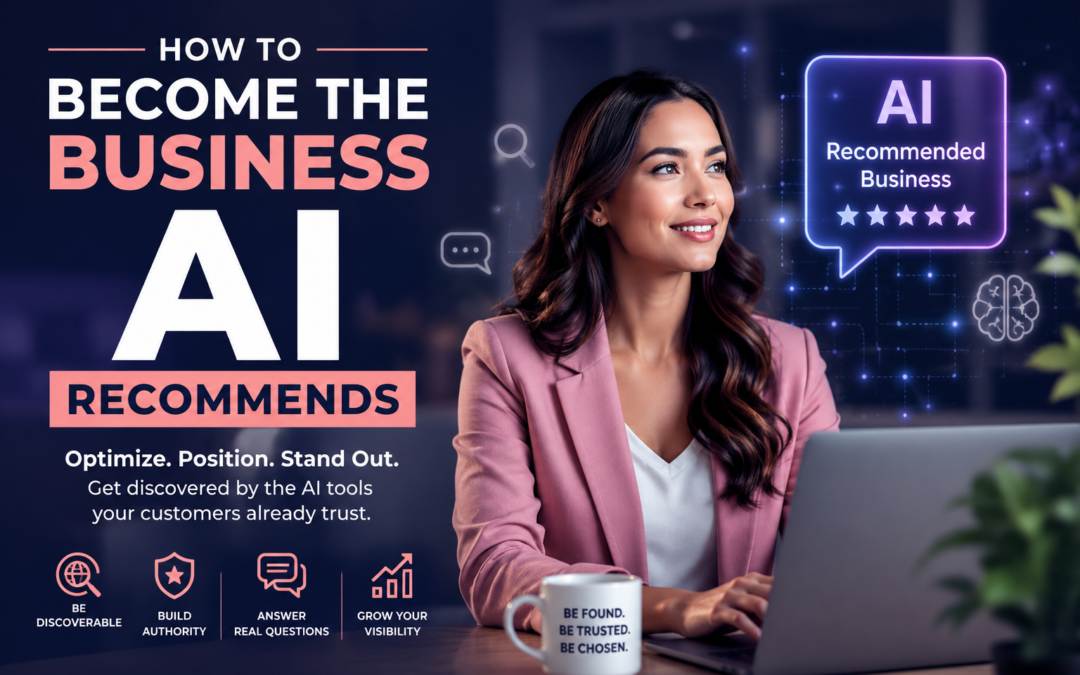
How women in ecommerce can show up where their customers are already looking
Picture this. A woman sits down with her laptop, opens ChatGPT, and types: “What’s the best sustainable skincare brand for sensitive skin?”
She doesn’t scroll through a list of ten blue links. She doesn’t click through three websites and compare. She reads a clean, confident answer — and the brand named in that answer gets her trust, her click, and almost certainly her credit card.
Now here’s the question that should stop you in your tracks: is that brand you?
If the honest answer is “probably not yet” — don’t worry. You’re in good company, and you’re in the right place. Because AI-powered search is the biggest shift in customer discovery since Google, and the businesses that move now will own the advantage for years to come. The ones who wait will spend those same years wondering where their traffic went.
This is your guide to becoming the business AI recommends first.
First, Let’s Talk About What’s Actually Happening
Not long ago, getting found online meant one thing: ranking on Google. You optimized your keywords, built your backlinks, and prayed to the algorithm gods. And if you played the game well enough, you landed on page one.
That game still matters. But a new one has started — and it has completely different rules.
In 2026, online visibility is no longer just about appearing on the first page of search results. It’s about becoming a trusted source that artificial intelligence platforms choose to reference, recommend, and surface to millions of users. Millions of people are no longer starting their searches on Google alone. They’re opening ChatGPT, Google Gemini, Perplexity, and Claude and asking questions the way they’d ask a knowledgeable friend … conversationally, specifically, trustingly.
And here’s the kicker: . This means fewer businesses get visibility — but those that do earn massive, instant trust.
Fewer businesses. Massive trust. You do the math.
Only 1.2% of businesses currently get recommended by AI. Which means 98.8% are completely invisible to the fastest-growing discovery channel on the internet. This is not a small gap to close. It’s a wide open door — and right now, it’s still early enough to walk through it.
Why This Matters Especially for Women in Ecommerce
Here’s something worth sitting with. Women make up nearly 85% of all consumer purchasing decisions. We are the buyers, the researchers, the “let me ask AI about this first” crowd. And increasingly, AI is who we ask.
Which means as a woman building a business for women — you are literally selling to the people who are already using these tools to find what you sell. The alignment is almost poetic.
But there’s more. Startups can beat larger incumbents on specificity, founder visibility, niche authority, speed of publication, and quality of proof. A solo expert can outrank larger brands in AI citations if the expert has a cleaner entity footprint and better topic depth.
Read that again. A solo expert can outrank larger brands.
You don’t need a massive marketing budget. You don’t need a team of SEO specialists. You need clarity, consistency, and the willingness to show up as the genuine authority you already are.
“The hardest truth is that many companies don’t have an SEO problem. They have a credibility distribution problem.” — Mean CEO Blog, 2026
That’s where we’re starting.
How AI Decides Who to Recommend
Before we talk strategy, you need to understand how AI tools actually make their recommendations — because it’s fundamentally different from how Google works.
Traditional SEO rewards technical optimization, link building, and content quantity. AEO — Answer Engine Optimization — rewards authority, answer quality, and trust signals to secure direct recommendations in AI responses. These are different disciplines that require different strategies and different measurements of success. You can dominate Google while remaining invisible to ChatGPT and Gemini.
AI tools are looking for four things:
1. Entity Authority — Does the internet agree on who you are and what you do? Is your name, niche, and expertise mentioned consistently across multiple credible sources?
2. Answer Quality — Does your content actually answer the questions your customers are asking? Not keyword-stuffed content — real, clear, specific answers.
3. Trust Signals — Reviews, mentions, press coverage, backlinks from credible sites. AI reads these as endorsements.
4. Consistency — Is your information the same everywhere? Your name, your niche, your contact details, your brand story. Inconsistency is a red flag to AI systems.
An AI recommendation usually looks like a direct mention (the AI explicitly names your brand in its response), a cited source (the AI links to your website as the factual authority), or a contextual suggestion (the AI recommends you based on the user’s specific prompt and geographic location).
Your goal is to become the obvious answer to the questions your ideal customers are already asking AI.
The Strategies That Actually Work
1. Own Your Niche — Specifically and Unapologetically
The biggest mistake ecommerce entrepreneurs make when trying to build AI visibility is being too broad. “Women’s fashion.” “Healthy food.” “Beauty products.” These are categories, not niches — and AI can’t recommend a category. It recommends the authority on something specific.
Think about what you do better, deeper, and more passionately than anyone else. Then claim that lane so clearly that AI has no choice but to associate your name with it.
Real example: Imagine a Latina entrepreneur who sells handmade ceramic cookware inspired by her grandmother’s kitchen in Oaxaca. She could position herself as a “kitchenware brand.” Or she could own the niche of traditional Mexican ceramic cookware for the modern home kitchen — with content, stories, and expertise that runs deep on that specific topic. One of those positions gets recommended by AI. The other gets lost in the noise.
“Don’t fixate on singular prompts — think topical authority. AI visibility should be measured as sustained topical authority, not isolated wins.” — Similarweb AI Brand Visibility Index, 2026
2. Write Content That Answers Questions, Not Just Keywords
AI search is driven by questions. That means businesses should create content that answers the questions people actually ask before they buy — not just keyword articles, but prompt-style articles.
Think about the questions your ideal customer types into ChatGPT before she buys what you sell. Write those questions down. Then answer them clearly, thoroughly, and in plain language she’d actually use.
Examples of prompt-style content for ecommerce:
- “What should I look for when buying natural skincare for rosacea?”
- “Is handmade jewelry worth the price compared to mass-produced?”
- “How do I know if a sustainable clothing brand is actually sustainable?”
- “What’s the difference between cold-pressed and expeller-pressed olive oil?”
Each of those questions is a blog post, a FAQ page, a product description, a YouTube video. Each one you answer well is another reason for AI to route a curious customer directly to you.
The story behind the strategy: Danielle, a small-batch candle maker in Atlanta, was struggling to stand out in a saturated market. She stopped writing generic product descriptions and started writing content around the questions she kept hearing from customers: “How long should a soy candle burn?” “Why does my candle tunnel?” “What’s the cleanest burning wax?” Within four months, her brand began appearing in Perplexity answers for candle-related queries. Her traffic from AI-referred sources grew 340% in a single quarter — without a single paid ad.
3. Build Your Digital Footprint — Everywhere That Matters
Your best chance of appearing on AI platforms depends on your ability to maintain a strong, current, accurate, and consistent online presence.
AI tools don’t just read your website. They cross-reference everything including your social profiles, your Google Business listing, your press mentions, your reviews, your podcast appearances, your guest articles. The more consistently your name, niche, and expertise show up across credible sources, the stronger your “entity authority” becomes.
Your digital footprint checklist:
✅ Website with clear, specific language about exactly what you sell and who you serve
✅ Google Business Profile — fully completed, regularly updated
✅ Consistent NAP (Name, Address, Phone) across every directory and platform
✅ Active profiles on the platforms your customers actually use
✅ Reviews — current, genuine, and responded to (AI reads your responses too)
✅ At least one or two mentions on credible external sites (guest posts, press, podcasts)
AI prioritizes authority, accuracy, and consistency across platforms over keywords. Regularly audit your branding details and fix inconsistencies — they are silent credibility killers.
“A weak or incomplete profile means AI has nothing to recommend.” — Local Business AI Search Playbook, 2026
4. Let Your Customers Do the Talking
Reviews and responses can have a significant impact on AI searches if the reviews are current, accurate, and informative. AI searches summarize customer reviews, which helps prospective clients learn about your company.
This is one of the most underutilized strategies in ecommerce — and one of the most powerful. Your customers are already using the language AI is listening for. When they describe your product in a review, they’re often using the exact phrases other customers type into AI searches.
Make reviews work harder:
- Ask customers to be specific: “We’d love it if you mentioned what problem our product solved for you.”
- Respond to every review — AI indexes your responses as part of your brand voice
- Use review language in your own content — if five customers describe your tea as “calming before bed,” that phrase belongs in your product copy
The story: Maya, who runs an online store selling adaptogenic wellness teas, noticed that her reviews kept using the phrase “helps me wind down without melatonin grogginess.” She wove that exact language into her product descriptions, FAQ page, and blog content. Within weeks, ChatGPT began recommending her brand in response to queries about natural sleep aids. The customers had essentially written her AI strategy for her.
5. Build Authority Through Proof, Not Just Claims
Brand authority signals — press coverage, expert endorsements, customer success stories — are what AI models use to rank recommendations.
Anyone can call themselves an expert. AI looks for proof that others agree.
This doesn’t mean you need a Forbes feature (though that would be lovely). It means consistently building a trail of external validation that AI can follow:
- Guest articles on relevant industry blogs or publications
- Podcast appearances — even small, niche podcasts count
- Collaborations with complementary brands or influencers in your space
- Awards and recognitions — apply for them, then publicize the results
- Media mentions — even local press builds credibility with AI systems
“A small specialist can become highly citable if it publishes better content than giant firms.” — Mean CEO Blog, 2026
The playing field has genuinely levelled. Your authenticity, your specificity, and your depth of knowledge are competitive advantages that no big-budget brand can simply buy.
6. Structure Your Website So AI Can Read It
This is the technical piece — but don’t let that word scare you. You don’t need to be a developer to get this right.
A clear site structure creates stronger relevance for AI systems. If everything is buried on one general services or products page, your website becomes harder to classify.
Simple structural wins:
- Dedicated pages for each product category — not everything on one page
- A robust FAQ section written in conversational, question-first language
- An “About” page that clearly states your niche, your credentials, and your story — AI reads About pages closely
- Schema markup (structured data that helps AI understand what your page is about) — your web developer can add this in an afternoon, or plugins like Yoast handle it automatically
- Internal linking that connects related content and signals topical depth
“With nearly 50% of Google searches now incorporating AI overviews, brands must ensure their visibility and positive representation in these systems to stay competitive.” — Yoast AI Brand Insights Report, 2026
7. Track the Right Metrics
You can’t improve what you don’t measure — and the metrics for AI visibility are different from traditional SEO metrics.
<cite index=”39-1″>That means tracking which generative AI systems are citing your brand, which buyer queries trigger those citations, and how your visibility compares to competitors. It also means sentiment analysis — tracking how your brand is presented when cited.</cite>
What to track:
- Referral traffic from ChatGPT, Perplexity, Google AI Overviews (visible in Google Analytics 4 under traffic sources)
- Brand mentions using tools like Google Alerts, Mention, or Brand24
- Which questions trigger recommendations in your niche — test it yourself by asking AI tools questions your customers would ask
- Your competitors’ AI visibility — ask ChatGPT who it recommends in your category and learn from what it says
A Day in the Life: What AI-Optimized Looks Like in Practice
Let’s make this concrete. Here’s what a week of AI visibility building looks like for a woman running an ecommerce business selling organic baby products:
Monday: Publish a blog post answering “What are the safest fabrics for newborn sensitive skin?” — a question she hears constantly from customers.
Tuesday: Respond to five recent product reviews, thanking customers specifically and weaving in keywords naturally: “So glad our organic cotton onesie worked well for your little one’s eczema.”
Wednesday: Pitch a guest post to a parenting blog with strong domain authority — not to sell, but to share genuine expertise about toxin-free baby care.
Thursday: Update her Google Business Profile with fresh photos and a new post about her latest collection.
Friday: Ask five recent customers if they’d be willing to leave a detailed review mentioning what problem the product solved.
None of these tasks takes more than 30–45 minutes. All of them build the consistent, credible, expert presence that AI systems look for when deciding who to recommend.
The Bigger Picture
Here’s what ties all of this together — and it’s the part that matters most.
Some businesses will try to game AI search. That is the wrong approach. AI search visibility should be built on real authority. The businesses most likely to benefit are the ones that actually create useful information and make their expertise easy to verify.
This is wonderful news for every woman in ecommerce who has been building something real.
Because the era of gaming your way to the top is over. The era of being genuinely, specifically, demonstrably good at what you do — and then making that goodness visible and verifiable — has arrived. And that’s a game you were already playing.
You started your business because you know something, make something, or solve something better than anyone else you know. You built it with intention, with care, with your whole self. Now it’s time to make sure the world — and the AI tools the world is increasingly trusting — can find you.
Your 30-Day AI Visibility Starter Plan
Week 1 — Clarify
- Write one sentence that defines your niche with razor-sharp specificity
- Audit your website, Google profile, and social bios for consistency
- List the top ten questions your customers ask before they buy
Week 2 — Create
- Publish two pieces of “prompt-style” content answering real customer questions
- Update your About page to clearly state your expertise, your niche, and your story
- Add a comprehensive FAQ page to your website
Week 3 — Build
- Request detailed reviews from five recent customers
- Identify two external sites where a guest post or feature would build authority
- Respond to every existing review on your Google profile
Week 4 — Track
- Open ChatGPT and Perplexity and ask the questions your customers ask — see who gets recommended
- Check Google Analytics for AI-referred traffic
- Set up a Google Alert for your brand name
Then do it again. Month after month. Because AI visibility, like all the best things in business, compounds. The effort you put in today becomes the authority that gets you recommended tomorrow — and the month after that, and the year after that.
Be Consistent
The businesses AI recommends first aren’t necessarily the biggest ones. They’re the clearest. The most consistent. The most genuinely, verifiably expert in their specific lane.
That description fits you.
Now go make sure AI knows it.
Enjoyed this article? Share it with a fellow woman in ecommerce who’s ready to be discovered. And if you want more strategies for building a business that stands out in the AI era, subscribe to the Women in Ecommerce newsletter — where real women share what’s actually working.

